








Mississippi football and quarterback Trinidad Chambliss are still aiming for another year of eligibility, despite the NCAA denying their claim Jan. 9.
Chambliss’ lawyers plan to file suit against the NCAA in Mississippi state court for a preliminary injunction, per multiple reports. Chambliss’ attorney, Tom Mars, released a statement Jan. 11, noting Chambliss’ team anticipates filing the suit before the end of the week.
”We expect the lawsuit to be far more detailed and documented than other eligibility lawsuits that have been filed in the past year,’ Mars said in a statement. ‘Therefore, considerable work needs to be done before we’ll be prepared to seek an injunction that would allow Trinidad to play next season.’
Chambliss, a first-year Division I starter after transferring from Division II Ferris State, was hoping to receive a retroactive redshirt for the 2022 season, in which he didn’t appear in a game due to medical issues. He also redshirted in 2021, meaning he only appeared in games for three seasons from 2023-25.
Ole Miss athletic director Keith Carter said on social media the school would appeal the NCAA’s decision after Chambliss was denied the extra season.
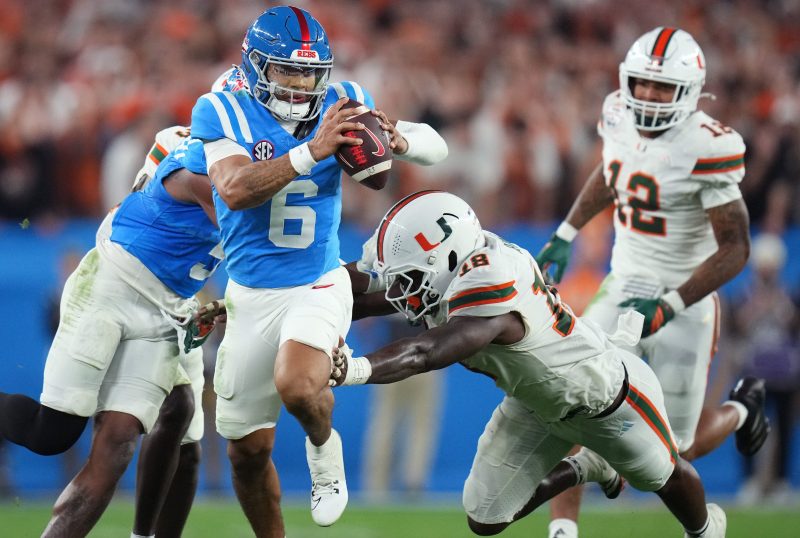
The breakout star of the College Football Playoff, Chambliss passed for 362 yards and two touchdowns in Ole Miss’ upset win over Georgia in the Sugar Bowl. He threw for 277 yards and a touchdown in the Rebels’ narrow 31-27 defeat to Miami at the Fiesta Bowl.
Chambliss finished the 2025-26 season with 3,937 passing yards and 22 touchdowns to three interceptions, along with 527 rushing yards and eight scores. He was eighth in Heisman Trophy voting. Ole Miss has since added former Auburn 5-star quarterback Deuce Knight, who has four seasons of eligibility left, via the transfer portal.
Why was Trinidad Chambliss’ waiver denied by NCAA?
‘In November, Ole Miss filed a waiver request for football student-athlete Trinidad Chambliss, seeking to extend his five-year Division I eligibility clock, citing an incapacitating illness or injury,’ the NCAA wrote. ‘Approval requires schools to submit medical documentation provided by a treating physician at the time of a student’s incapacitating injury or illness, which was not provided. The documents provided by Ole Miss and the student’s prior school include a physician’s note from a December 2022 visit, which stated the student-athlete was “doing very well” since he was seen in August 2022. Additionally, the student-athlete’s prior school indicated it had no documentation on medical treatment, injury reports or medical conditions involving the student-athlete during that time frame and cited “developmental needs and our team’s competitive circumstances” as its reason the student-athlete did not play in the 2022-23 season. The waiver request was denied.
‘This decision aligns with consistent application of NCAA rules. So far this academic year, the NCAA has received 784 clock extension requests (438 in football). Of those, 25 cases cited an incapacitating injury (nine in football). The NCAA approved 15 of those (six in football), and all 15 provided medical documentation from the time of the injury. Conversely, all 10 that were denied (three in football) did not provide the required medical documentation.
‘To receive a clock extension, a student-athlete must have been denied two seasons of competition for reasons beyond the student’s or school’s control, and a “redshirt” year can be used only once. One of the rules being cited publicly (Bylaw 12.6.4.2.2) is not the correct rule for the type of waiver requested by the school. Ole Miss applied for the waiver in November, and the NCAA first provided a verbal denial Dec. 8.’