

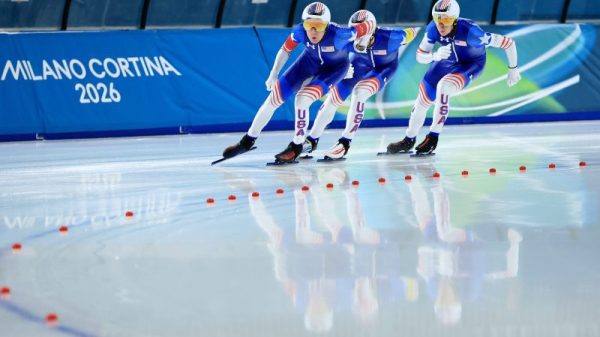




CORTINA D’AMPEZZO, Italy — Conor McDermott-Mostowy was never one for team sports.
Growing up in Washington, D.C., speedskating appealed to him more than hockey. He didn’t like the idea of other people depending on him. When he laced up his skates, McDermott-Mostowy only wanted to be held accountable to himself.
There was more to it than that, though. A more subconscious deterrent from sharing the blame and the glory of whatever transpired out on the ice with other people. Team sports were not a place for closeted gay kids like him.
Now he’s one of a record-breaking – according to Outsports – 49 out LGBTQ+ athletes at the 2026 Milan Cortina Winter Olympics. An encouraging number, albeit small (equal to about 21.1% of Team USA). Still, McDermott-Mostowy is glad to be part of “the last generation to grow up without representation in sport.”
“You have to believe it to achieve it,” he told USA TODAY. “Seeing more queer people, especially, I feel like, seeing more gay or queer men in sports is really important.”
There are eight out LGBTQ+ athletes competing for Team USA at the 2026 Olympics. Seven of them are women – downhill skiing gold medalist Breezy Johnson, figure skating gold medalist Amber Glenn, snowboarder Maddy Schaffrick, speedskater Brittany Bowe and hockey players Hilary Knight, Alex Carpenter and Cayla Barnes. And then there’s McDermott-Mostowy.
Johnson spoke with USA TODAY about her decision to come out publicly as bisexual in 2022. Growing up, she wanted to be a champion. “More than I wanted my favorite color to be blue or that I wanted pasta for dinner or whatever,” Johnson said. “I wanted to be good at skiing.”
That meant doing what the greats do. Which, at that point, meant being straight or keeping part of your identity a secret. At least until retirement.
Before her boyfriend Connor Watkins proposed to her at the finish line after her super-G run in Cortina, Johnson referenced a lyric in singer Maddie Zahm’s song “You Might Not Like Her”: “Convinced you’re not bi ‘cause you’re way too into guys.”
“That really resonated with me as a concept,” Johnson said. “I just was like, ‘I don’t have to deal with this other side. I’m really good at compartmentalizing and putting things in boxes, and so I’ll just do that.’
“… In seeing other athletes that were out, I was like, ‘OK, maybe you don’t have to let it get dusty before you open it up.’ So that was my aim in coming out, and I hope that kids take that. That they can be any version of themselves. Whether that’s somebody who likes Legos or somebody who’s openly gay.”
A big moment for McDermott-Mostowy was when freeskier Gus Kenworthy came out in an ESPN The Magazine cover story 11 years ago. Back then, it felt to McDermott-Mostowy like athletes only came out after retirement or if they managed to be so exceptional that no one could hold their identity against them. He calls it “a culture of fear.” Fear of blowback within the sport. Fear of the media’s reaction. Fear of sponsorships falling apart.
But Kenworthy’s story meant a lot to McDermott-Mostowy, who had been skating for a few years at that point, nearing his move to long track at age 17. While he’s sure people around him knew he was gay before he officially came out to them after Kenworthy’s public declaration, McDermott-Mostowy still felt the same pressures Johnson described.
You can be yourself out in the open when you’re done being an athlete.
Now, the contingent of openly queer athletes is big enough to be its own country (20th largest in 2026). As of Tuesday morning in Italy, Team LGBTQ has six medals – with dozens of athletes still competing – which would tie South Korea for 12th among all nationals. The gay dating app Grindr also announced it was enhancing its privacy features this month to protect LGBTQ+ athletes.
Many athletes have spoken about feeling “mixed emotions” representing the United States at the Olympics. They’ve used their access to sports’ biggest stage to draw attention to topics they hold dear, LGBTQ+ athletes included.
McDermott-Mostowy feels there’s never been a more important time for queer people to compete for Team USA. From bathroom bans to restrictions around the discussion of pronouns and sexual orientation in schools to even the recent news of President Donald Trump removing the pride flag from the Stonewall National Monument in New York City. McDermott-Mostowy feels an obligation to be visible.
“Team USA is so diverse,” he said. “Team USA has so many queer people on it, and other identifiers, and we’re so good because of that. I think that’s really important for people back home to see. But I also feel like on a global stage, it’s really important to be competing right now and show the world that the United States is not a monolith.”
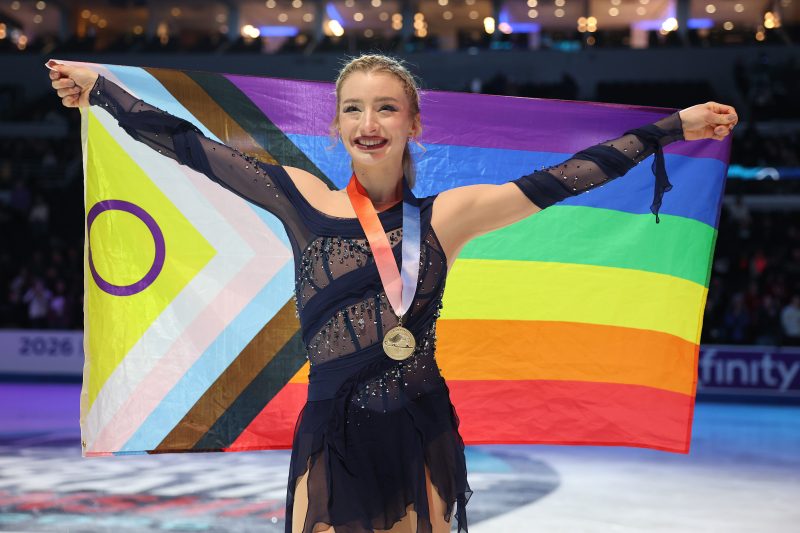
Glenn, who is pansexual, made history as the first openly queer Olympic women’s figure skater. She posted pictures of her and teammate Alysa Liu with their team skate gold medals on TikTok with the caption: “They hate to see two woke bitches winning.’
“If ‘Woke’ means people who use their platforms to advocate for marginalized communities in the country that they are actively representing…….’ Glenn continued, ‘Then yeah sure?”
And to those who respond to athlete’s criticisms of home with, “Shut up and skate,” McDermott-Mostowy says the Olympics have always been political.
Take the USA’s boycott of the 1980 Summer Olympics in Moscow. Or Adolf Hitler’s use of the 1936 Berlin Games as pro-Nazi propaganda. If world leaders can use this Olympics to further their own diplomatic interest, why can’t athletes?
“We’re not here just as entertainment for you,” McDermott-Mostowy said. “…if you want to enjoy us on the field of play, you also need to sit back and listen.”
Reach USA TODAY Network sports reporter Payton Titus at ptitus@gannett.com, and follow her on X @petitus25.