





Before NFL free agency can begin in earnest, teams have some spring cleaning to do with their respective rosters.
By the start of the new league year on March 11, all teams must be compliant with the league’s salary cap. That leaves less than a month for teams to release players no longer in their plans. Though the process is already underway with the Miami Dolphins parting this week with former standouts Tyreek Hill and Bradley Chubb, it should ramp up in the days after the NFL scouting combine. And there could be a significant crop of distinguished names joining the rest of the free agents on the open market.
Here are 20 notable players who could be cut in the coming weeks, with all salary cap information courtesy of Over The Cap:
QB Kirk Cousins, Atlanta Falcons
A January restructure of Cousins’ contract seemed to confirm that the veteran passer wouldn’t be back for a third season in Atlanta. With his artificially inflated 2027 base salary of $67.9 million set to become guaranteed if he is not released by the start of the new league year, all signs point to a separation in the coming weeks. The four-time Pro Bowler still might be an intriguing free agent option for teams looking for a bridge quarterback or at least some competition behind center. The Falcons, meanwhile, can continue to distance themselves from the mistakes of the past two years by owning up to their most costly one.
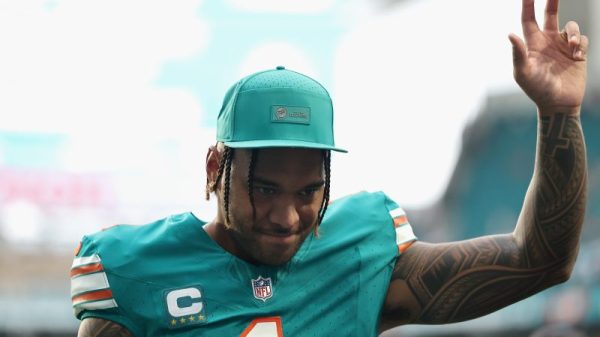
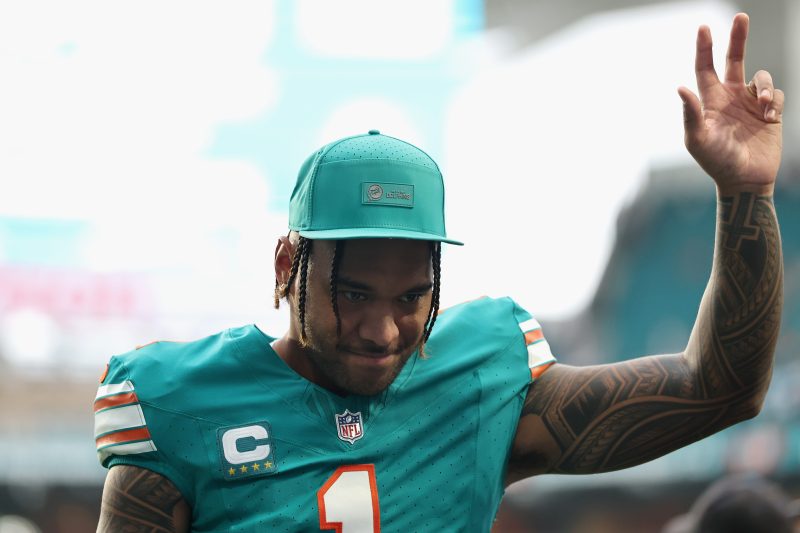
QB Tua Tagovailoa, Miami Dolphins
For most teams highlighted on this list, any split is typically spurred by the pursuit of financial flexibility. For the Dolphins, however, pursuing one form of football freedom entails boxing themselves in on their books. Ending Tagovailoa’s run would saddle the team with a record $99.2 million dead cap hit, which would represent nearly a third of the franchise’s spending capacity. Miami could spread that out over two years, but it also might be uniquely positioned to absorb it in one fell swoop as the franchise gears up for a transition season. A trade would be optimal, but finding a taker seems almost impossible given the current terms of the quarterback’s deal.
QB Justin Fields, New York Jets
Not much mystery surrounding this move. Gang Green gambled on Fields by giving him $30 million guaranteed on a two-year deal, and the investment almost immediately went bust. Even with the team’s plans behind center unclear, there’s no real hope of a career reclamation for the quarterback in New York. Cutting Fields would only confer $1 million in cap savings if done with a pre-June 1 designation, but sending him on his way figures to be another step the organization will take to try to put last season behind it.
RB James Conner, Arizona Cardinals
Kyler Murray’s potential exit might not be the only change afoot in Arizona’s backfield. Coming off a season-ending ankle injury and set to turn 31 in May, Conner might not be in the plans for a team likely to embrace a youth movement. The bruising back performed admirably for a Cardinals offense that once leaned on its potent ground game. But while losing a team leader might be tough to stomach, carving out a $9.8 million cap hit for an older back with an unclear health outlook would be unreasonable.
RB Aaron Jones, Minnesota Vikings
Minnesota’s cap outlook – currently at a league-worst $43 million in the red – necessitates an offseason approach that more closely resembles shearing than pruning. That could put the likes of tight end T.J. Hockenson and center Ryan Kelly in the team’s crosshairs. But the most notable option on offense might be Jones, who carries an untenable $14.55 million cap hit after posting a career-low 4.2 yards per carry in 2025. Set to turn 32 next season, the veteran ball carrier is a far cry from the breakaway threat he was in previous years. It’s probably time for the Vikings to embrace a changing of the guard in the backfield.
RB Joe Mixon, Houston Texans
There was perhaps no bigger injury mystery in the 2025 season than Mixon, who missed the entire season with what general manager Nick Caserio recently called a ‘freak’ foot issue. The two-time Pro Bowler’s outlook remains murky, with the team still seeking intel on his recovery. It’s not as though a Texans ground game that ranked 29th in yards per carry has a bevy of existing competition for him, but the move for Houston should be adding a more dynamic ball carrier either in free agency or the draft. The former option becomes easier if the team cuts Mixon and recoups $8 million in cap space.
WR Michael Pittman Jr., Indianapolis Colts
The Colts are at a crossroads in configuring their receiving corps. Impending free agent Alec Pierce looks poised to cash in on a 1,000-yard receiving season in which he led the NFL with 21.3 yards per catch. Regardless of whether Indianapolis can keep him, it probably can’t trudge forward with Pittman, who is set to carry a cap hit of $29 million. That would rank the sixth-highest figure for any receiver, a sum entirely too rich for a player who looks to serve in more of a complementary role coming off his 784-yard campaign. Restructuring might be a preferable route, but it could be hard to resist the $24 million in space that could be gained by moving on.
WR Calvin Ridley, Tennessee Titans
With an estimated NFL-high $103.5 million in available cap space, Tennessee doesn’t have to be concerned with financial flexibility as it evaluates its existing roster. But there’s little incentive for general Mike Borgonzi to stand pat with Ridley, who hasn’t come close to living up to the four-year, $92 million deal he signed with the Titans’ previous regime. As he comes off a season in which he played just seven games due to a broken fibula, the 31-year-old pass catcher almost assuredly would have to take a pay cut to remain in place. But Tennessee might be inclined to part with him and ramp up its spending power even more as it tries to surround Cam Ward with a more potent receiving corps.
TE Jonnu Smith, Pittsburgh Steelers
Acquired last summer as an added piece in the Jalen Ramsey-Minkah Fitzpatrick trade, the 2024 Pro Bowl tight end figured to help patch up a receiving corps that lacked legitimate threats beyond DK Metcalf. Instead, Smith posted his fewest receiving yards (222) since his rookie campaign, barely making a dent beyond his work as an outlet for Aaron Rodgers. Now, offensive coordinator Arthur Smith is out and new head coach – and play-caller – Mike McCarthy is in. Even if Rodgers returns, stomaching a nearly $10.9 million cap hit for a 30-year-old target who only muddles the tight end room shouldn’t be on the table for Pittsburgh. The Steelers should take the $7 million in savings and move on.
C Elgton Jenkins, Green Bay Packers
Green Bay might like to see how the two-time Pro Bowl selection at left guard might fare in a full season at center after his 2025 campaign was cut short by a fractured fibula in Week 10. But with Jenkins carrying a $24.3 cap hit next season, the experiment seems destined to end here. Green Bay can recoup $19.5 million by cutting ties here, a move that might rise to the level of necessity as the team navigates several substantial cap commitments in the coming years. Re-signing Sean Rhyan, who filled in for Jenkins down the stretch, could settle the question at the pivot.
G Mekhi Becton, Los Angeles Chargers
Seems there’s plenty of remorse to go around after Becton joined the Bolts last offseason on a two-year, $20 million deal. The right guard on multiple occasions aired out his frustrations with his new setting, saying after the season that since-fired offensive coordinator Greg Roman’s scheme ‘was a lot of different things I’m not used to.’ The 6-foot-7, 363-pounder looks ill-suited for offensive coordinator Mike McDaniel’s wide-zone scheme, and Los Angeles can save $9.7 million of the $12.2 million cap hit it would take on by keeping Becton.
OT Jawaan Taylor, Kansas City Chiefs
Since the Chiefs signed him to a splashy four-year, $80 million contract in 2023, Taylor has had a high profile for all the wrong reasons. The right tackle has long become a lightning rod for his deep alignments and early jumps, earning him penalties that have plagued his career. Freeing up $20 million by parting with Taylor is perhaps the most straightforward remedy for Kansas City to address its financial woes. Jaylon Moore can hold down the right side as his replacement.
DE Rashan Gary, Green Bay Packers
When Micah Parsons arrived in an unexpected trade just before the season, the Packers’ pass rush seemed bound to benefit from an edge rusher who commands a good deal of attention and resources from opposing offenses. While Parsons proved to be a true force multiplier prior to being lost to a torn anterior cruciate ligament, Gary didn’t live up to his end of the bargain. Though he matched his 2024 Pro Bowl season sack total of 7½, his pressure rate ticked downward yet again with a career-low 12.1%, according to Next Gen Stats. When his disruption was sorely needed for a line down the stretch that lost Parsons and Devonte Wyatt, Gary made next to no impact. Justifying his $16 million cap hit would be extremely difficult for a team that has myriad other commitments to its young core.
DE Bryce Huff, San Francisco 49ers
Any notion of Huff recapturing his 10-sack form of 2023 has probably been dispelled by his lackluster showings since that campaign. With Nick Bosa and rookie Mykel Williams sidelined last season, Huff couldn’t provide much of a jolt to San Francisco’s edge rush, tallying just four sacks despite playing a career-high 56% of the team’s defensive snaps. With a cut only opening up $5.4 million in cap savings, a pay cut could be possible.
DT Javon Hargrave, Minnesota Vikings
As they look to reset on several missteps by since-dismissed general manager Kwesi Adofo-Mensah, the Vikings might have some difficult decisions to make. Not this one, though. Hargrave didn’t make enough of a dent after Minnesota signed him to a two-year, $30 million contract last March. A 33-year-old with diminishing pass-rush production is a luxury for a team facing a cap crunch.
OLB Uchenna Nwosu, Seattle Seahawks
Could the defending champions really send one of the standouts of their Super Bowl run packing? Beyond hauling in the pick-six that punctuated the Seahawks’ romp over the Patriots, Nwosu recorded seven sacks on the season, serving up a reminder of his ability after playing in just six games in each of the last two years. Seattle is hardly hurting for cap space, but Nwosu is currently set to have the third-highest cap hit on the team at just shy of $20 million. Keeping a deep rotation of effective pass rushers isn’t easy, and the Seahawks might have to reflect on how to make the math work. But with fellow edge rusher Boye Maye potentially heading elsewhere in free agency, there’s probably a path forward for a player of whom general manager John Schneider has been highly complimentary.
LB Tremaine Edmunds, Chicago Bears
His four interceptions and overall respectable play at the second level factored into the emergence of an opportunistic Bears defense. But Edmunds has yet to blossom into the consistent difference-maker the Bears pegged him as when they handed him a market-setting four-year, $72 million deal in 2023. Chicago likely will have to find some different solutions at the second level, with the $15 million in cap savings too enticing to pass up.
CB Marshon Lattimore, Washington Commanders
Acquiring Lattimore at the trade deadline in 2024 was one of the earliest signs that Washington’s brain trust would be aggressive in trying to capitalize on a rapid ascension led by Jayden Daniels. It also marked the start of a run of regrettable moves that have prompted a reckoning for the defense. With no guaranteed money remaining, Lattimore can be cut and have his entire $18.5 million cap hit be wiped out. The Commanders can bolster their free-agency spending capacity and try a different route to address a back end that remains a liability.
CB Marlon Humphrey, Baltimore Ravens
Something has to give for Baltimore with the four-time Pro Bowler. Humphrey’s nearly $26.3 million cap hit – the third-highest figure for any cornerback – is incongruous with his performance in 2025, when he was one of the league’s leakiest cover men. But without a post-June 1 designation, cutting him would entail a nearly $19 million dead cap hit. That might not be a preferred route for general manager Eric DeCosta and new coach Jesse Minter. But Humphrey’s current price tag is far too exorbitant for a player who has been repeatedly burned in coverage and is set to turn 30 this summer.
CB L’Jarius Sneed, Tennessee Titans
Of all the ill-fated steps in the Titans’ $228 million spending spree in 2024, the trade for Sneed might stand alone as the organization’s worst move. Not only did Tennessee sign the cornerback to a four-year, $76.4 million extension after landing him, it gave up a third-round pick to secure his services. Sneed played in just 12 games over the last two years, and he was woefully ineffective in coverage last year prior to being sidelined. Clearing $11.4 million in cap space isn’t as important as wiping the slate clean.