












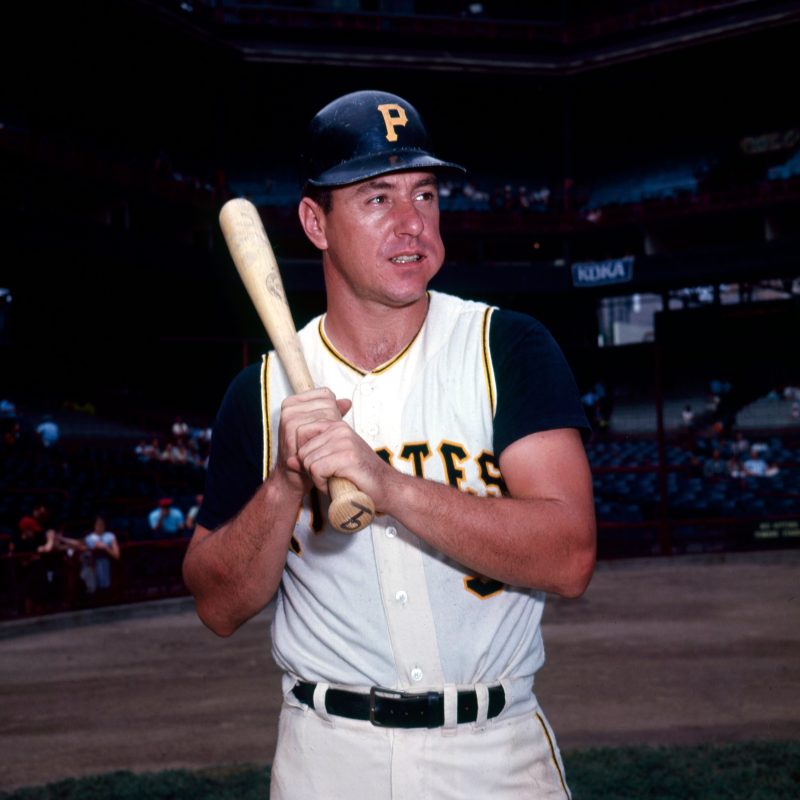
Bill Mazeroski, the Gold Glove former second baseman of the Pittsburgh Pirates who danced around the bases after his bottom-of-the-ninth, solo home run beat the New York Yankees in Game 7 of the 1960 World Series, died at the age of 89.
“The author of one of the game’s most indelible moments, Bill Mazeroski will be remembered as one of baseball’s most respected figures – both for his character and for his brilliance on the field as one of the game’s best second basemen,’ Baseball Hall of Fame chairman Jane Forbes Clark said.
‘Maz remained humble about his career, even as he was celebrated in Cooperstown. On behalf of his Hall of Fame family, we send our deepest sympathies to his loved ones and to Pirates fans everywhere.”
Mazeroski was an amazing defensive player who could turn the double play in a blink. He was a shortstop when he signed with the Pirates in 1954, at 17, but Branch Rickey promptly moved him to second base.
Late Pirates broadcaster Bob Prince called Mazeroski ‘The Glove.’ He had the defensive statistics to back up his excellence, and they helped put him in the National Baseball Hall of Fame in 2001.
But as a career .260 hitter, he also got a big boost in that induction from his monumental homer – still marked by a plaque on a Pittsburgh sidewalk where it cleared the left field wall at since-demolished Forbes Field. Today there is a statue of Mazeroski outside Pittsburgh’s PNC Park.
Mazeroski was 24 on that Oct. 13, 1960, day when, at 3:36 p.m. ET, he blasted into baseball immortality against the Yankees. He was 64 and white-haired in 2001 when he got a private tour of his exhibit at the Hall of Fame in Cooperstown, New York, a few days before his induction.
On that tour, he recalled to USA TODAY Sports that he was ‘floating’ as he rounded the bases in 1960 after hitting a one-ball, no-strike slider for a home run off Yankees pitcher Ralph Terry. The ball barely cleared the ivy-covered wall.
‘Fantastic. It’s something unbelievable that you just never would expect to happen to you,’ Mazeroski said then. ‘All of a sudden, here it is. It gets a little overwhelming.’
Who has the ball?
In 2010, on the 50th anniversary of the home run, Mazeroski told USA TODAY Sports’ Mike Dodd that as the kid of a coal miner he grew up dreaming of hitting a home run to win a World Series: ‘But it was with a broomstick and a bucket of stones. I wore out a lot of broomsticks, (pretending), ‘I’m Babe Ruth and I’m hitting a home run to win the Series.’ ‘
While Pittsburgh partied that 1960 day, Mazeroski and his wife, Milene, went to a quiet park to savor the moment.
The home run ball won’t be on display at the Hall of Fame. Several fans claimed to have it.
‘Everybody wanted a hundred bucks,’ Mazeroski said. ‘There were so many of them, nobody knew for sure. I have one or two.’
Unlike a typical Hall of Fame visitor, he alone knew just how that bat in a third floor display case felt in his hands when he used it to hit his World Series-winning homer against the Yankees.
‘You can still see the spot on the seams where I hit the ball. It dug into the bat,’ Mazeroski said during his 2001 Hall tour.
Defense his calling card
Mazeroski didn’t get close to 3,000 hits (2,016) or 300 homers (138).
But defense is part of the game, too. On his Hall of Fame tour, as he passed a wall of balls from no-hit pitching performances, he saw one from a 1970 no-hitter by former Pirate Dock Ellis against the San Diego Padres.
‘I saved that one,’ Mazeroski said of the no-hitter. ‘Line drive up the middle. I dove and backhanded it about a foot off the ground.’
He won eight Gold Gloves, but the gloves he actually used looked as if they wouldn’t bring a buck at a yard sale.
“It’s pretty simple: He was the best I ever saw at turning a double play,’ Hall of Famer Joe Torre said of Mazeroski.
He figured he used about four gloves from 1956 to 1972, and they were barely gloves at all. He liked them small, and he always removed the padding from the heel for better feel. When a glove wore out, he got it fixed and kept using it.
The Hall has one which Mazeroski used at various times.
‘This was one of the good ones,’ he said on the pre-induction tour, slipping on the mitt and pounding it. ‘When a ball hit in there, it just closed.’
But the gloves also helped him get the ball out of his hands quickly on double plays. Balls bounced off the heel of his glove into his throwing hand. No second baseman turned as many double plays in a career (1,706) or a season (161 in 1966).
That skill didn’t get him into the Hall in 15 years of eligibility on voting by baseball writers. He was elected by the Veterans Committee.
‘I never thought that I hit enough to get in the Hall of Fame,’ Mazeroski said.
‘I didn’t think they would put defense in. I’m glad they did. … I don’t know everybody’s (batting) average in the Hall of Fame. In fact, I don’t know anybody’s, really. I don’t know if there’s anybody worse than .260. Is .260 the lowest?’
No. Turn-of-the-century catcher Ray Schalk hit .253. Shortstop Rabbit Maranville hit .258. Harmon Killebrew, a home run slugger, hit .256.
‘But defense wins as many games as offense wins or anything else,’ Mazeroski said. ‘You turn a double play, that’s like hitting a grand slam sometimes.’
As a Pirate, Mazeroski played two exhibition games in Cooperstown. The Hall has a score sheet from a 1959 game in which he homered twice.
‘I didn’t even remember that,’ he said. ‘I do remember we had a home run contest before the game, and I beat Ted Kluszewski.’
His 1960 World Series homer triggered a massive celebration in Pittsburgh. At the Hall’s archives, his wife spotted a photo of that day in Pittsburgh, its streets piled with paper.
‘Bill, look at this picture,’ said his wife, a former Pirates secretary. ‘These cars are old. These buildings are old. Are we this old?’ she asked with a laugh.
Mazeroski grew up in a one-room home in southeastern Ohio coal country in the community of Rush Run. Hall of Famers from nearby include baseball’s Phil Niekro, basketball’s John Havlicek and football’s Lou Groza.
In retirement in the Pittsburgh area, Mazeroski enjoyed fishing and golf: ‘If I’m hitting the ball bad in golf, I go fishing. If I’m not catching any fish, I go golfing.’